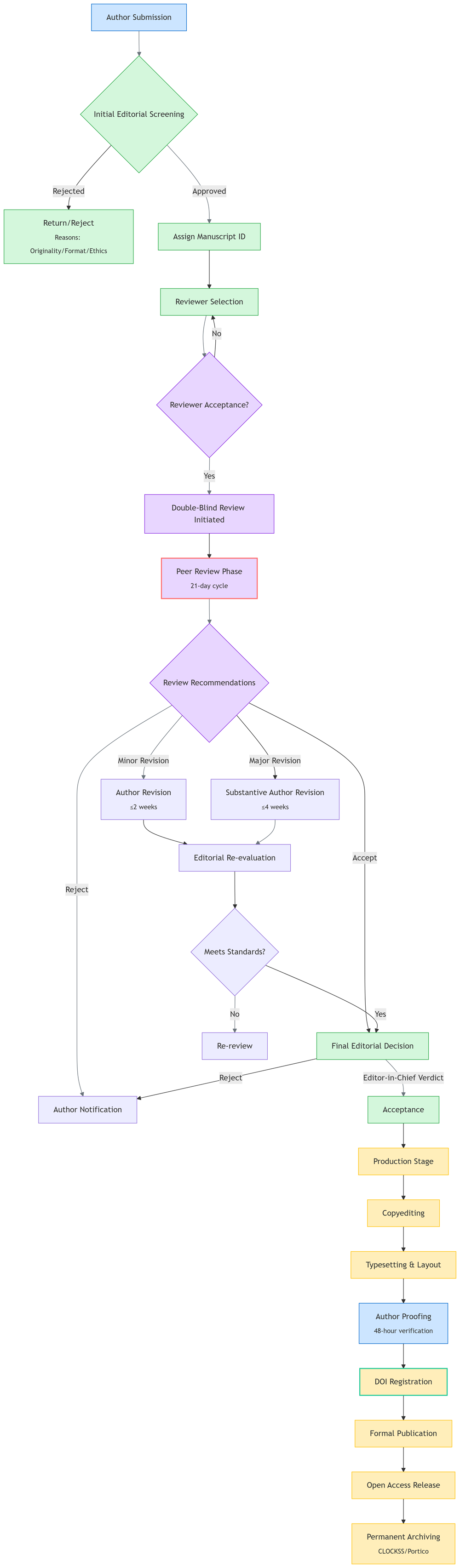
Peer Review Process
Peer Review Process
All manuscripts submitted to Global Waste Valorization (GWV) undergo a rigorous double-blind peer review process, in which the identities of both authors and reviewers are concealed throughout the review process, where practicable. The peer review process is designed to support fair, objective, confidential, and independent evaluation while maintaining high standards of academic integrity, scientific rigor, and research quality.
01 Submission and Initial Editorial Screening
Upon submission, each manuscript undergoes an initial editorial screening by the editorial office or an assigned editor. This stage is intended to determine whether the manuscript is suitable for further consideration and whether it meets the journal’s basic editorial, ethical, and technical requirements.
The initial screening may include an assessment of:
- Scope and relevance in relation to the journal’s Aims and Scope;
- Scientific and methodological soundness at a preliminary level;
- Compliance with submission requirements, including manuscript structure, formatting, language, and required declarations;
- Publication ethics, including potential plagiarism, duplicate or redundant publication, authorship concerns, conflicts of interest, and other relevant ethical issues;
- Completeness of essential submission information, including funding, data availability, and other applicable statements.
02 Reviewer Selection and Assignment
Manuscripts that pass the initial editorial screening are normally sent to at least two independent and suitably qualified reviewers with relevant expertise. Reviewers are selected according to the subject matter of the manuscript and their academic or professional expertise.
Reviewers should have appropriate knowledge and experience in waste valorization, resource recovery, circular economy, environmental engineering, materials, biotechnology, or other relevant areas.
Reviewers should be able to provide an independent and objective assessment of the manuscript.
Reviewers should not have a known conflict of interest with the authors, institutions, or research described in the manuscript.
Reviewers are expected to maintain the confidentiality of the manuscript and the review process.
Where practicable, the journal may also consider appropriate institutional and geographic diversity when selecting reviewers. The number of reviewers may vary when necessary, for example, when additional expertise is required or when a reviewer is unable to complete an assigned review.
03 Double-Blind Peer Review
Under the journal’s double-blind peer review model, the identities of authors and reviewers are not disclosed to each other during the review process. Authors should therefore ensure that the submitted manuscript and supplementary files do not unnecessarily reveal their identities or affiliations where anonymization is required.
04 Review Criteria
Reviewers are generally asked to consider the following aspects of a manuscript, as applicable to the article type and research field:
Originality, importance, and potential contribution of the research to waste valorization and related fields.
Appropriateness and soundness of the research methodology, experimental design, data analysis, and interpretation.
Logical structure, clarity of presentation, and appropriate organization of the manuscript.
Accuracy and adequacy of results, interpretation, conclusions, and assessment of practical implications.
Quality, relevance, and appropriate use of scholarly literature supporting the research.
Ethical compliance, research transparency, data availability, and reproducibility where applicable.
For studies involving waste streams, waste characterization, material recovery, resource recovery, recycling, reuse, conversion technologies, biological or chemical processes, environmental applications, or circular economy systems, reviewers may also consider the appropriateness of the study design, material or feedstock characterization, process conditions, analytical methods, data quality, environmental implications, resource efficiency, and the relevance of the proposed valorization pathway.
05 Reviewer Comments and Recommendations
Reviewers provide written comments identifying the strengths and weaknesses of the manuscript and, where appropriate, suggestions for improvement. Reviewers may recommend an editorial outcome such as:
06 Editorial Decision
After the peer review reports have been received, the editor evaluates the manuscript and the reviewers’ recommendations. Where reviewer opinions differ substantially, the editor may seek an additional review, request further clarification, or make an editorial decision based on the available evidence and relevant expertise.
Authors are notified of the editorial decision and, where applicable, receive the reviewers’ comments. Reviewer identities remain confidential in accordance with the journal’s double-blind review policy.
07 Revision and Re-evaluation
When a manuscript is invited for revision, authors should carefully address the reviewers’ and editor’s comments and submit:
- A revised version of the manuscript with all changes incorporated; and
- A point-by-point response explaining how each substantive comment has been addressed.
Authors should clearly indicate where changes have been made in the revised manuscript, where appropriate.
A revised manuscript may be returned to the original reviewers or evaluated by new reviewers, depending on the nature of the revisions and the editor’s assessment. Further rounds of revision and review may be requested when necessary.
08 Appeal of an Editorial Decision
Authors who believe that an editorial decision was based on a significant factual error, a demonstrable misunderstanding of the manuscript, or a substantive procedural problem may submit an appeal to the editorial office.
An appeal should provide a clear and evidence-based explanation of the grounds for reconsideration and should identify the specific issue in question. Appeals are considered by the editorial team, and the journal may seek additional editorial or peer-review input where appropriate.
An appeal does not guarantee that the original decision will be changed.
09 Acceptance and Production
Once a manuscript is formally accepted, it enters the copyediting, proofreading, and production process. Depending on the article and journal workflow, this may include:
- Language editing and editorial formatting;
- Typesetting and page layout;
- Verification of bibliographic and article metadata;
- Author proofreading and correction of production errors;
- Final preparation for online publication.
Authors are expected to review the proofs carefully and promptly report any factual, typographical, or production errors. Substantive changes to the accepted manuscript should not normally be introduced at the proof stage unless they are necessary and approved by the editor.
10 Publication and Post-Publication
Following final publication, the article is assigned a Digital Object Identifier (DOI) and made available through the journal’s online platform in accordance with the journal’s publishing and licensing policies.
After publication, authors and readers may identify errors or concerns relating to the published article. Where necessary, the journal may publish an appropriate correction, retraction, or other post-publication notice in accordance with the journal’s publishing ethics policies.
Published content is preserved through the journal’s applicable digital archiving and preservation arrangements to support the long-term accessibility of the scholarly record.
↗ Peer Review and Publication Workflow