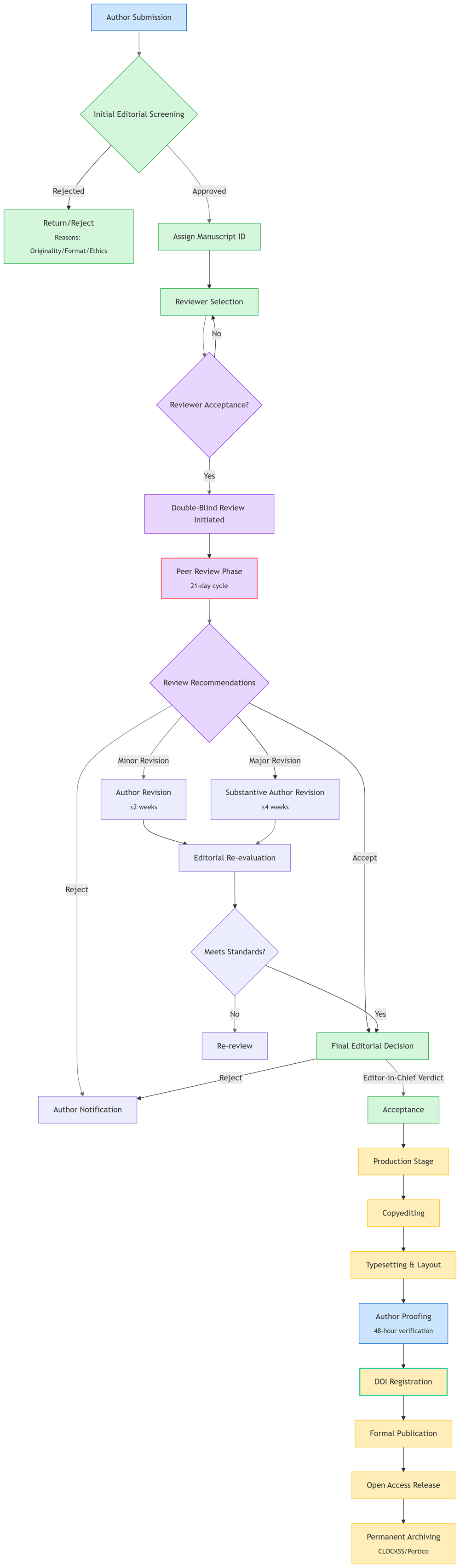
Peer Review Process
All manuscripts submitted to Transnational Supply Chain Research (TSCR) undergo a rigorous double-blind peer review process, in which the identities of authors and reviewers are concealed where practicable. The process is designed to support a fair, objective, confidential, and independent evaluation of submitted manuscripts and to uphold high standards of academic integrity, methodological rigor, research quality, and transparency in transnational supply chain research.
01 Submission and Initial Editorial Screening
Upon submission, each manuscript undergoes an initial editorial assessment by the editorial office. The purpose of this stage is to determine whether the manuscript is suitable for further consideration and whether it meets the journal's basic requirements.
The editorial team considers:
- Relevance to the journal's Aims and Scope;
- Compliance with submission guidelines, formatting requirements, and ethical compliance;
- Similarity Check (iThenticate) , including potential plagiarism, duplicate or redundant publication;
- Completeness of submission materials and required declarations;
- Basic academic quality, originality, and suitability for peer review.
Manuscripts that do not meet the journal's basic requirements or fall outside its scope may be returned to the authors for appropriate revision or declined without external peer review.
02 Reviewer Selection and Assignment
Manuscripts that pass the initial editorial assessment are normally sent to at least two independent and qualified reviewers with appropriate expertise in the subject area.
Depending on the manuscript, reviewer expertise may include:
Supply chain management, logistics, transportation, warehousing, procurement, distribution, and inventory management.
Operations management, production systems, manufacturing, service operations, and process optimization.
Artificial intelligence, machine learning, digital transformation, information systems, analytics, and emerging supply chain technologies.
Cross-border trade, international logistics, global supply networks, international business, and transnational supply chain systems.
Reviewers are selected according to their relevant expertise and independence. Potential conflicts of interest are considered before reviewer assignment, and reviewers are expected to maintain the confidentiality of the manuscript and the review process.
03 Double-Blind Peer Review
TSCR uses a double-blind peer review model. Where practicable, the identities of both authors and reviewers are concealed during the review process.
Reviewers are expected to provide an independent and constructive assessment of the manuscript. Their evaluation should be based on the scholarly content of the submission rather than on the authors' identity, institutional affiliation, geographic location, or other unrelated characteristics.
Reviewers must treat submitted manuscripts and all associated review materials as confidential. Manuscripts should not be shared, discussed, or used for purposes unrelated to the review without appropriate authorization.
04 Review Criteria
Reviewers evaluate manuscripts according to the nature and methodology of the research. Key considerations may include:
Originality of the research question, contribution to the field, and significance of the findings.
Appropriateness of research design, data sources, sampling, analytical methods, models, and statistical or computational approaches.
Logical structure, clarity of argument, quality of presentation, and consistency between objectives, methods, results, and conclusions.
Adequacy of evidence, validity of analysis, interpretation of results, and whether conclusions are supported by the research.
Contribution to supply chain theory, management practice, policy, operations, logistics, or related fields.
Research ethics, transparency of methods and data where appropriate, conflicts of interest, and compliance with publication standards.
Depending on the study, reviewers may also consider supply chain network design, procurement and sourcing, logistics and transportation, inventory and operations management, supply chain resilience and risk, sustainability, circular supply chains, international and cross-border trade, digital transformation, artificial intelligence and analytics, supply chain visibility, collaboration, performance measurement, and socioeconomic or institutional factors affecting transnational supply chains.
05 Reviewer Comments and Recommendations
Reviewers provide written comments that identify the manuscript's strengths, limitations, methodological concerns, and areas requiring clarification or improvement.
Reviewers may provide recommendations such as:
Reviewer recommendations are advisory. The final editorial decision is made by the responsible editor after considering the reviewers' comments, the manuscript, and other relevant editorial considerations.
06 Editorial Decision
The editor considers the reviewer reports together with the manuscript’s academic quality, relevance, originality, methodological rigor, ethical compliance, and suitability for the journal.
Authors are informed of the editorial decision and, where applicable, receive the relevant reviewer comments. Reviewer identities remain confidential in accordance with the journal’s double-blind review policy.
Editorial decisions may include acceptance, a request for minor or major revision, or rejection.
07 Revision and Re-evaluation
When revisions are requested, authors should carefully address the reviewers' and editor's comments and provide a point-by-point response explaining how each substantive issue has been addressed.
The revised manuscript may be evaluated by the original reviewers, additional reviewers, or the editor, depending on the nature and extent of the revisions. Further rounds of revision and re-evaluation may be requested when necessary before a final editorial decision is reached.
Authors should ensure that revisions accurately reflect the research and that any changes to the manuscript remain consistent with the underlying data, methodology, analysis, and conclusions.
08 Appeal of an Editorial Decision
Authors may request reconsideration of an editorial decision when they believe that a significant factual error, methodological misunderstanding, procedural issue, or other substantive concern may have affected the decision.
An appeal should clearly explain the grounds for reconsideration and address the relevant editorial or reviewer comments with specific evidence or clarification. Appeals are considered by the editorial team in accordance with the journal's editorial policies.
Submitting an appeal does not guarantee that the original decision will be changed.
09 Acceptance and Production
Once a manuscript is accepted, it enters the copyediting, proofreading, and production phase. This stage may include:
- Language editing and formatting for consistency with the journal's style;
- Typesetting and layout preparation;
- Author proofreading and correction of production errors;
- Final preparation and scheduling for publication.
Authors remain responsible for reviewing proofs and notifying the editorial office of any necessary corrections. Changes at this stage should normally be limited to corrections necessary to ensure the accuracy, clarity, and integrity of the published article.
10 Publication and Post-Publication
Following publication, each article is assigned a Digital Object Identifier (DOI) and made openly accessible through the journal's online platform in accordance with the journal's open-access publishing model.
Published articles remain part of the scholarly record and are maintained for long-term accessibility and preservation in accordance with applicable publishing and digital preservation practices.
Post-publication concerns, including substantive errors or issues affecting the integrity of the published record, may be addressed through appropriate corrections, retractions, or other editorial notices in accordance with the journal's publishing ethics policies.
Peer Review and Publication Workflow