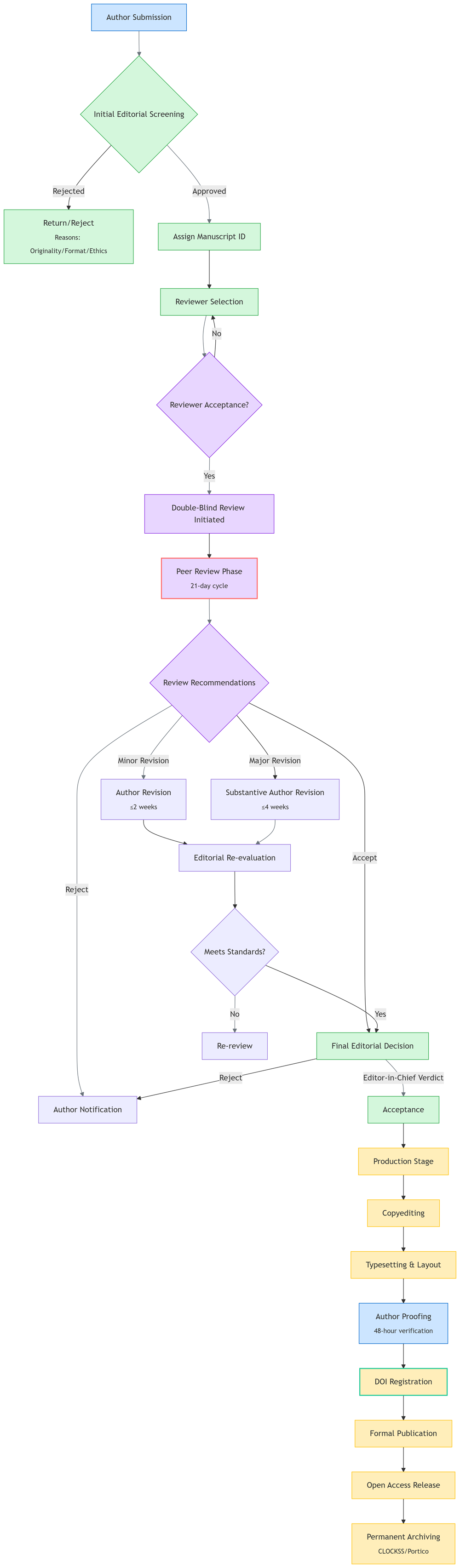
Peer Review Process
All manuscripts submitted to Smart Ship Technologies (SST) are subject to a rigorous double-blind peer review process, in which the identities of authors and reviewers are concealed to support a fair, objective, confidential, and independent evaluation. The peer review process is designed to uphold high standards of academic integrity, scientific rigor, engineering quality, and research transparency in smart ship technologies and related maritime research.
01 Submission and Initial Editorial Screening
Upon submission, each manuscript undergoes an initial editorial assessment by the editorial office. During this stage, the editorial team assesses whether the manuscript is suitable for further consideration based on:
- Relevance to the journal's Aims and Scope;
- Compliance with submission guidelines, formatting requirements, and ethical compliance;
- Similarity Check (iThenticate) , including potential plagiarism, duplicate or redundant publication;
- Completeness of submission materials and required declarations;
- Basic academic quality, originality, and suitability for peer review.
Manuscripts that do not meet the journal’s basic requirements or are outside its scope may be returned to the authors for correction or declined before external peer review.
02 Reviewer Selection and Assignment
Manuscripts that pass the initial editorial assessment are normally sent to at least two independent and qualified reviewers with relevant expertise.
Reviewers are selected according to their expertise in areas relevant to the manuscript, including smart ship technologies, naval architecture, marine engineering, ship propulsion, marine energy systems, automation, control systems, digitalization, maritime operations, marine systems, or related fields.
Reviewers should be sufficiently independent from the authors and should not have relationships that could compromise the objectivity of the review.
Reviewers are expected to disclose any actual, potential, or perceived conflicts of interest before accepting an assignment.
Reviewers must treat manuscripts and associated materials as confidential and must not use unpublished information for personal or professional advantage.
03 Double-Blind Peer Review
Smart Ship Technologies uses a double-blind peer review model. Where practicable, the identities of both authors and reviewers are concealed throughout the review process.
Reviewers are expected to provide independent, constructive, and evidence-based assessments. Authors are not informed of reviewer identities, and reviewers are not provided with identifying information about the authors beyond what is necessary for the evaluation of the manuscript.
Reviewers should focus on the scientific and engineering content and should not allow personal, institutional, geographic, commercial, or other irrelevant considerations to influence their assessment.
04 Review Criteria
Reviewers evaluate manuscripts according to criteria appropriate to the research type and subject area. Key considerations may include:
Whether the manuscript presents an original contribution and addresses a meaningful scientific, engineering, or technological problem.
Whether the research design, engineering approach, experiments, simulations, models, algorithms, measurements, or analyses are appropriate and technically sound.
Whether the manuscript presents its objectives, methods, results, discussion, and conclusions clearly and logically.
Whether the results are adequately supported by the evidence and whether the conclusions are consistent with the findings.
Whether the proposed technology, system, methodology, or application is relevant to smart ships, maritime engineering, or related marine technology.
Whether the study follows relevant ethical requirements and provides sufficient information concerning data, methods, models, experiments, software, or other materials to support appropriate evaluation and reproducibility.
05 Reviewer Comments and Recommendations
Reviewers provide written comments that are intended to help the editor assess the manuscript and, where appropriate, help authors improve the quality, clarity, technical soundness, and scientific reliability of their work.
Reviewer recommendations may include:
Reviewer recommendations are advisory. The final editorial decision is made by the responsible editor based on the overall evidence, reviewer reports, and the journal’s editorial standards.
06 Editorial Decision
The editor considers the reviewer reports together with the manuscript’s scientific and engineering quality, relevance, originality, ethical compliance, and suitability for the journal.
Authors are informed of the editorial decision and, where applicable, receive the relevant reviewer comments. Reviewer identities remain confidential in accordance with the journal’s double-blind review policy.
Editorial decisions may include acceptance, a request for minor or major revision, or rejection.
07 Revision and Re-evaluation
When revisions are requested, authors should address the reviewers’ comments carefully and provide a point-by-point response explaining how each substantive comment has been addressed or, where appropriate, providing a reasoned response when a suggested change is not adopted.
The revised manuscript may be returned to the original reviewers or, where appropriate, evaluated by other qualified reviewers. More than one round of revision and re-evaluation may be required before a final editorial decision is reached.
08 Appeal of an Editorial Decision
Authors who believe that an editorial decision was based on a significant misunderstanding of the manuscript, a substantive procedural issue, or a demonstrable error in the evaluation may submit an appeal to the editorial office.
An appeal should clearly identify the manuscript and provide a concise, evidence-based explanation of the grounds for reconsideration. Appeals should not simply restate disagreement with a reviewer’s scientific or technical opinion.
09 Acceptance and Production
Once a manuscript is formally accepted, it enters the copyediting, proofreading, and production phase. This may include:
- Language editing and editorial formatting;
- Typesetting and page layout;
- Preparation of the final article files;
- Author proofreading and correction of factual or production errors;
- Final editorial checks and scheduling for publication.
Authors remain responsible for carefully reviewing the proofs and confirming the accuracy of the final version, particularly with respect to scientific and technical content, author information, affiliations, figures, tables, references, and other publication details.
10 Publication and Post-Publication
After publication, each article receives a Digital Object Identifier (DOI) and is made openly accessible through the journal’s online platform in accordance with the journal’s open-access publishing model.
Published articles remain part of the scholarly record and may be subject to post-publication corrections, retractions, or other editorial notices when necessary. The journal maintains appropriate arrangements for the long-term preservation and accessibility of its published content.
Peer Review and Publication Workflow