
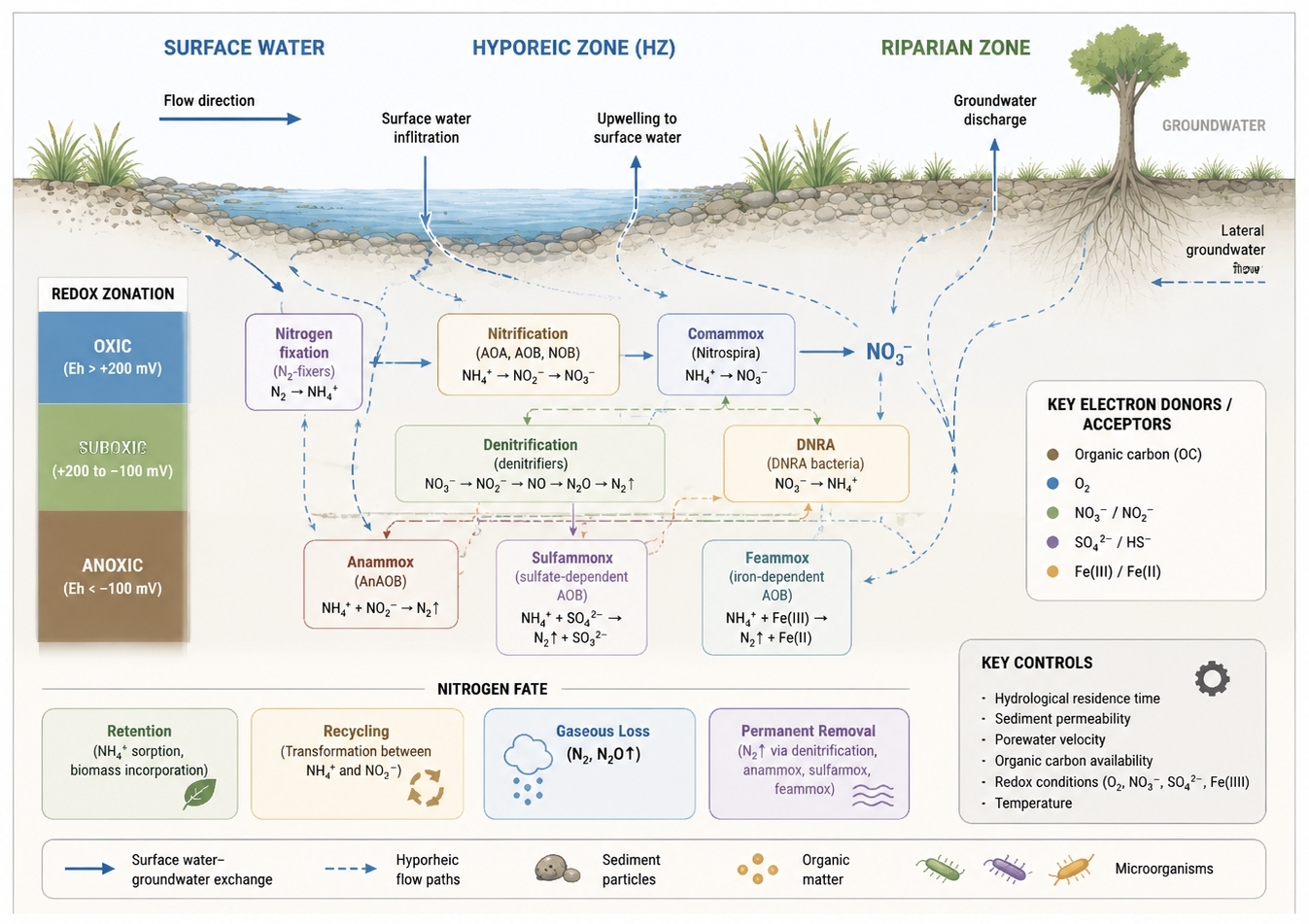
Microbial Nitrogen Transformation in Hyporheic–riparian Zones: Integrating Molecular Ecology and Biogeochemical Perspectives
Article Sidebar
 View
PDF
View
PDF
Information Fusion
 How to Cite
Similar Articles
- Mbah Chinedu Gabriel, Novel Soybean soapstock Biodiesel Synthesis through Esterification/Transesterification Reactions using Multiple Solvents , Synthetic Ecological Engineering: Vol. 1 No. 1 (2025)
- A. Arunprasath, V. Sankara Vel, S. Sreeram, Community Structure, Species Diversity and Ethnobotanical aspects in flora of Karattumedu Hillock, Tamil Nadu , Synthetic Ecological Engineering: Vol. 1 No. 1 (2025)
You may also start an advanced similarity search for this article.
Main Article Content
Authors
 ,
,
,
,
Article Details
References
[1]Pajares, S., & Bohannan, B. J. M. (2016). Ecology of nitrogen fixing, nitrifying, and denitrifying microorganisms in tropical forest soils. Frontiers in Microbiology, 7, 1045. https://doi.org/10.3389/fmicb.2016.01045
[2]Valiente, N., Jirsa, F., Hein, T., Wanek, W., Prommer, J., Bonin, P., & Gómez-Alday, J. J. (2022). The role of coupled DNRA-anammox during nitrate removal in a highly saline lake. Science of the Total Environment, 806(3), 150726. https://doi.org/10.1016/j.scitotenv.2021.150726
[3]Fowler, D., Coyle, M., Skiba, U., Sutton, M. A., Cape, J. N., Reis, S., Sheppard, L. J., Jenkins, A., Grizzetti, B., Galloway, J. N., Vitousek, P., Leach, A., Bouwman, A. F., Butterbach-Bahl, K., Dentener, F., Stevenson, D., Amann, M., & Voss, M. (2013). The global nitrogen cycle in the twenty-first century. Philosophical Transactions of the Royal Society B: Biological Sciences, 368(1621), 20130164. https://doi.org/10.1098/rstb.2013.0164
[4]Krause, S., Lewandowski, J., Grimm, N. B., Hannah, D. M., Pinay, G., McDonald, K., Martí, E., Argerich, A., Pfister, L., Klaus, J., Battin, T., Larned, S. T., Schelker, J., Fleckenstein, J., Schmidt, C., Rivett, M. O., Watts, G., Sabater, F., Sorolla, A., & Turk, V. (2017). Ecohydrological interfaces as hot spots of ecosystem processes. Water Resources Research, 53(8), 6359–6376. https://doi.org/10.1002/2016WR019516
[5]Yin, T., Feng, M., Qiu, C., & Peng, S. (2022). Biological nitrogen fixation and nitrogen accumulation in peatlands. Frontiers in Earth Science, 10, 670867. https://doi.org/10.3389/feart.2022.670867
[6]Abdulhamid, Y., Duan, L., Yaqiao, S., & Hu, J. (2024). Unveiling the dynamic of nitrogen through migration and transformation patterns in the groundwater level fluctuation zone of a different hyporheic zone sediment. Scientific Reports, 14(1), 3954. https://doi.org/10.1038/s41598-024-54571-2
[7]Sharma, P., Bano, A., Singh, S. P., Dubey, N. K., Chandra, R., & Iqbal, H. M. N. (2022). Microbial fingerprinting techniques and their role in the remediation of environmental pollution. Cleaner Chemical Engineering, 2, 100026. https://doi.org/10.1016/j.clce.2022.100026
[8]Bernhardt, E. S., & Palmer, M. A. (2011). River restoration: The fuzzy logic of repairing reaches to reverse catchment scale degradation. Ecological Applications, 21(6), 1926–1931. https://doi.org/10.1890/10-1574.1
[9]Merill, L., & Tonjes, D. J. (2014). A review of the hyporheic zone, stream restoration, and means to enhance denitrification. Critical Reviews in Environmental Science and Technology, 44(21), 2337–2379. https://doi.org/10.1080/10643389.2013.829769
[10]Ward, A. S. (2016). The evolution and state of interdisciplinary hyporheic research. Wiley Interdisciplinary Reviews: Water, 3(1), 83–103. https://doi.org/10.1002/wat2.1120
[11]Krause, S., et al. (2017). Ecohydrological interfaces as hot spots of ecosystem processes. Water Resources Research, 53(8), 6359–6376. https://doi.org/10.1002/2016WR019516
[12]Boano, F., Harvey, J. W., Marion, A., Packman, A. I., Revelli, R., Ridolfi, L., & Wörman, A. (2014). Hyporheic flow and transport processes: Mechanisms, models, and biogeochemical implications. Reviews of Geophysics, 52(4), 603–679. https://doi.org/10.1002/2012RG000417
[13]Woods, H. A., Legault, G., Kingsolver, J. G., Pincebourde, S., Shah, A. A., & Larkin, B. G. (2022). Climate-driven thermal opportunities and risks for leaf miners in aspen canopies. Ecological Monographs, 92(4), e1544. https://doi.org/10.1002/ecm.1544
[14]Glatzel, S., & Herndl, G. J. (2021). Recognizing the complexity of soil organic carbon dynamics in vegetated coastal habitats. Global Change Biology, 27(1), 3–4. https://doi.org/10.1111/gcb.15426
[15]Kuypers, M. M. M., Marchant, H. K., & Kartal, B. (2018). The microbial nitrogen-cycling network. Nature Reviews Microbiology, 16(5), 263–276. https://doi.org/10.1038/nrmicro.2018.9
[16]Han, P., Wu, D., Sun, D., Zhao, M., Wang, M., Wen, T., Zhang, J., Hou, L., Liu, M., Klümper, U., Zheng, Y., Dong, H.-P., Liang, X., & Yin, G. (2021). N₂O and NOᵧ production by the comammox bacterium Nitrospira inopinata in comparison with canonical ammonia oxidizers. Water Research, 190, 116728. https://doi.org/10.1016/j.watres.2020.116728
[17]Liu, X., Gao, M., Wang, J., Gu, Z., & Cheng, G. F. (2022). Characteristics of denitrification and anammox in the sediment of an aquaculture pond. Frontiers in Environmental Science, 10, 1023835. https://doi.org/10.3389/fenvs.2022.1023835
[18]Xie, T., Liu, X., Xu, Y., Bryson, S., Zhao, L., Huang, K., Huang, S., Li, X., Yang, Q., Dong, H.-Y., & Winkler, M.-K. H. (2023). Coupling methanotrophic denitrification to anammox in a moving bed biofilm reactor for nitrogen removal under hypoxic conditions. Science of the Total Environment, 856(Pt. 1), 158795. https://doi.org/10.1016/j.scitotenv.2022.158795
[19]Glatzel, S., & Herndl, G. J. (2021). Recognizing the complexity of soil organic carbon dynamics in vegetated coastal habitats. Global Change Biology, 27(1), 3–4. https://doi.org/10.1111/gcb.15426
[20]Niu, G. Y., Yang, Z. L., Dickinson, R. E., Luo, Y. P., Hu, H. A. W., Thornton, P. E., Lawrence, P. J., Leung, R., Oleson, B., Lawrence, D. M., Bonan, G. B., Denning, S. S., & Slater, A. G. (2014). An integrated modelling framework of catchment-scale ecohydrological processes: 1. Model description and tests over an energy-limited watershed. Ecohydrology, 7(2), 427–439. https://doi.org/10.1002/eco.1362
[21]Woods, H. A., Legault, G., Kingsolver, J. G., Pincebourde, S., Shah, A. A., & Larkin, B. G. (2022). Climate-driven thermal opportunities and risks for leaf miners in aspen canopies. Ecological Monographs, 92(4), e1544. https://doi.org/10.1002/ecm.1544
[22]Lewandowski, J., Arnon, S., Banks, E., Batelaan, O., Betterle, A., Broecker, T., Coll, C., Drummond, J. D., Garcia, J. G., Galloway, J., Gomez-Velez, J., Grabowski, R. C., Herzog, S. P., Hinkelmann, R., Höhne, A., Hollender, J., Horn, M. A., Jaeger, A., Krause, S., ... Wu, L. (2019). Is the hyporheic zone relevant beyond the scientific community? Water, 11(11), 2230. https://doi.org/10.3390/w11112230
[23]Liu, Y., Liu, C., Nelson, W. C., Shi, L., Xu, F., Liu, Y., Yan, A., Zhong, L., Thompson, C., Fredrickson, J. K., & Zachara, J. M. (2017). Effect of water chemistry and hydrodynamics on nitrogen transformation activity and microbial community functional potential in hyporheic zone sediment columns. Environmental Science & Technology, 51(9), 4877–4886. https://doi.org/10.1021/acs.est.6b05018
[24]Ye, F., Duan, L., Sun, Y., Yang, F., Liu, R., Gao, F., Wang, Y., & Xu, Y. (2023). Nitrogen removal in freshwater sediments of riparian zone: N-loss pathways and environmental controls. Frontiers in Microbiology, 14, 1239055. https://doi.org/10.3389/fmicb.2023.1239055
[25]Storey, R. G., Williams, D. D., & Fulthorpe, R. R. (2004). Nitrogen processing in the hyporheic zone of a pastoral stream. Biogeochemistry, 69(3), 285–313.
[26]Li, S., Liao, Y., Pang, Y., Dong, X., Strous, M., & Ji, G. (2022). Denitrification and dissimilatory nitrate reduction to ammonia in long-term lake sediment microcosms with iron(II). Science of the Total Environment, 807, 150835. https://doi.org/10.1016/j.scitotenv.2021.150835
[27]She, Y., Qi, X., Xin, X., He, Y., Wang, W., & Li, Z. (2023). Insights into microbial interactive mechanism regulating dissimilatory nitrate reduction processes in riparian freshwater aquaculture sediments. Environmental Research, 216(Pt. 2), 114593. https://doi.org/10.1016/j.envres.2022.114593
[28]Wang, S., Wang, W., Zhao, S., Wang, X., Hefting, M. M., Schwark, L., & Zhu, G. (2019). Anammox and denitrification separately dominate microbial N-loss in water saturated and unsaturated soils horizons of riparian zones. Water Research, 162, 139–150. https://doi.org/10.1016/j.watres.2019.06.052
[29]Torgeson, J. M., Rosenfeld, C. E., Dunshee, A. J., Duhn, K., Schmitter, R., O'Hara, P. A., Ng, G. H. C., & Santelli, C. M. (2022). Hydrobiogeochemical interactions in the hyporheic zone of a sulfate-impacted, freshwater stream and riparian wetland ecosystem. Environmental Science: Processes & Impacts, 24(9), 1360–1382. https://doi.org/10.1039/D2EM00024E
[30]Liu, L.-Y., Xie, G.-J., Xing, D.-F., Liu, B.-F., Ding, J., Cao, G.-L., & Ren, N.-Q. (2021). Sulfate dependent ammonium oxidation: A microbial process linked nitrogen with sulfur cycle and potential application. Environmental Research, 192, 110282. https://doi.org/10.1016/j.envres.2020.110282
[31]Liu, L. Y., Wang, X., Dang, C. C., Zhao, Z. C., Xing, D. F., Liu, B. F., Ren, N. Q., & Xie, G. J. (2024). Anaerobic ammonium oxidation coupled with sulfate reduction links nitrogen with sulfur cycle. Bioresource Technology, 403, 130903. https://doi.org/10.1016/j.biortech.2024.130903
[32]Ding, B., Luo, W., Qin, Y., & Li, Z. (2020). Effects of the addition of nitrogen and phosphorus on anaerobic ammonium oxidation coupled with iron reduction (Feammox) in the farmland soils. Science of the Total Environment, 737, 139849. https://doi.org/10.1016/j.scitotenv.2020.139849
[33]Li, D., Wei, W., Xu, W., Li, C., Yang, Y., Chu, Z., & Zheng, B. (2025). The interactive application and impacts of iron/nitrogen biogeochemical cycling in distributed ponds for non-point source pollution control in a watershed. Journal of Environmental Management, 379, 124797. https://doi.org/10.1016/j.jenvman.2025.124797
[34]She, Y., Qi, X., Xin, X., He, Y., Wang, W., & Li, Z. (2023). Non-rhizosphere reinforces the contributions of Feammox and anammox to nitrogen loss than rhizosphere in riparian zones. Environmental Research, 239(Pt. 1), 117317. https://doi.org/10.1016/j.envres.2023.117317
[35]Chen, Z., Zhou, S., Yan, J., & Liu, A. (2024). A new method for nitrogen removal in wastewater treatment: Synergistic nitrogen removal using Feammox and nitrate-dependent Fe(II) oxidation within organic carbon environments. Water, 16(23), 3496. https://doi.org/10.3390/w16233496
[36]Chen, Y., Zhang, Q., Chen, Q., Xiao, L., Yan, H., & Lin, Y. (2025). Water-level fluctuations rather than water content changes induced by reservoir operation impact bacterial functioning for nitrogen transformation in riparian zones. ACS ES&T Water, 5(2), 670–677. https://doi.org/10.1021/acsestwater.4c00748
[37]Zhang, L., Liu, Y., Jin, M., Liang, X., Krause, S., Schneidewind, U., Li, Y., & Zhan, H. (2023). Influence of seasonal water-level fluctuations on depth-dependent microbial nitrogen transformation and greenhouse gas fluxes in the riparian zone. Journal of Hydrology, 622, 129676. https://doi.org/10.1016/j.jhydrol.2023.129676
[38]Yusuf, A., Jiang, Y., Abdullahi, A., Li, M., Duan, S., & Zhang, Y. (2025). Bacterial-fungal interactions in soil ecosystems: From biocontrol and niche partitioning to biogeochemical impacts. Fungal Ecology, 78, 101471. https://doi.org/10.1016/j.funeco.2025.101471
[39]Wang, Z., Wang, L., Li, Y., Zou, Y., Hou, X., & Wang, L. (2024). How redox gradient potentially influences nitrate reduction coupled with sulfur cycling: A new insight into nitrogen cycling in the hyporheic zone of effluent-dominated rivers. Science of the Total Environment, 915, 170070. https://doi.org/10.1016/j.scitotenv.2024.170070
[40]Niu, G. Y., Paniconi, C., Troch, P. A., Scott, R. L., Durcik, M., Zeng, X., Huxman, T., & Goodrich, D. C. (2014). An integrated modelling framework of catchment-scale ecohydrological processes: 1. Model description and tests over an energy-limited watershed. Ecohydrology, 7(2), 427–439. https://doi.org/10.1002/eco.1362
[41]Lyu, C., Li, X., Yu, H., Song, Y., Gao, H., & Yuan, P. (2023). Insight into the microbial nitrogen cycle in riparian soils in an agricultural region. Environmental Research, 231(Pt. 1), 116100. https://doi.org/10.1016/j.envres.2023.116100
[42]Yusuf, A., Li, M., Zhang, S.-Y., Odedishemi-Ajibade, F., Luo, R.-F., Wu, Y.-X., Zhang, T.-T., Yunusa Ugya, A., Zhang, Y., & Duan, S. (2025). Harnessing plant–microbe interactions: Strategies for enhancing resilience and nutrient acquisition for sustainable agriculture. Frontiers in Plant Science, 16, 1503730. https://doi.org/10.3389/fpls.2025.1503730
[43]Wang, S., Wang, X., Jiang, Y., Han, C., Jetten, M. S. M., Schwark, L., & Zhu, G. (2021). Abundance and functional importance of complete ammonia oxidizers and other nitrifiers in a riparian ecosystem. Environmental Science & Technology, 55(8), 4573–4584. https://doi.org/10.1021/acs.est.0c00915
[44]Nawaz, T., Fahad, S., Gu, L., Xu, L., & Zhou, R. (2025). Harnessing nitrogen-fixing cyanobacteria for sustainable agriculture: Opportunities, challenges, and implications for food security. Nitrogen, 6(1), 16. https://doi.org/10.3390/nitrogen6010016
[45]Yusuf, A., Lei, D., Sun, Y., Duan, S., & Zhang, Y. (2025). Nitrogen transformation and microbial community interactions in hydrodynamic heterogeneous hyporheic zone sediment: Insights for ecosystem sustainability. Limnologica, 112, 126252. https://doi.org/10.1016/j.limno.2025.126252
[46]Stach, T. L., Starke, J., Bouderka, F., Bornemann, T. L. V., Soares, A. R., Wilkins, M. J., Goldman, A. E., Stegen, J. C., Borton, M. A., & Probst, A. J. (2025). Conserved environmental adaptations of stream microbiomes in the hyporheic zone across North America. Microbiome, 13(1), 253. https://doi.org/10.1186/s40168-025-02236-1
[47]Wang, Y., Wang, Y., Shang, J., Wang, L., Li, Y., Wang, Z., Zou, Y., Cai, W., & Wang, L. (2024). Redox gradients drive microbial community assembly patterns and molecular ecological networks in the hyporheic zone of effluent-dominated rivers. Water Research, 248, 120900. https://doi.org/10.1016/j.watres.2023.120900
[48]Oshiki, M., Satoh, H., & Okabe, S. (2016). Ecology and physiology of anaerobic ammonium oxidizing bacteria. Environmental Microbiology, 18(9), 2784–2796. https://doi.org/10.1111/1462-2920.13134
[49]Séneca, J., Söllinger, A., Herbold, C. W., Pjevac, P., Prommer, J., Verbruggen, E., Sigurdsson, B. D., Peñuelas, J., Janssens, I. A., Urich, T., Tveit, A. T., & Richter, A. (2021). Increased microbial expression of organic nitrogen cycling genes in long-term warmed grassland soils. ISME Communications, 1(1), 69. https://doi.org/10.1038/s43705-021-00073-5
[50]Qu, Q., Wang, S., Hu, X., & Mu, L. (2024). The impact of anthropogenic pressures on microbial diversity and river multifunctionality relationships on a global scale. Science of the Total Environment, 950, 175293. https://doi.org/10.1016/j.scitotenv.2024.175293
[51]Gaby, J. C., & Buckley, D. H. (2012). A comprehensive evaluation of PCR primers to amplify the nifH gene of nitrogenase. PLOS ONE, 7(7), e42149. https://doi.org/10.1371/journal.pone.0042149
[52]Baumann, K. B. L., Mazzoli, A., Salazar, G., Ruscheweyh, H.-J., Müller, B., Niederdorfer, R., Sunagawa, S., Lever, M. A., Lehmann, M. F., & Bürgmann, H. (2024). Metagenomic and -transcriptomic analyses of microbial nitrogen transformation potential, and gene expression in Swiss lake sediments. ISME Communications, 4(1), ycae110. https://doi.org/10.1093/ismeco/ycae110
[53]Harvey, J. W., Böhlke, J. K., Voytek, M. A., Scott, D., & Tobias, C. R. (2013). Hyporheic zone denitrification: Controls on effective reaction depth and contribution to whole-stream mass balance. Water Resources Research, 49(10), 6298–6316. https://doi.org/10.1002/wrcr.20492
[54]Liu, R., Liu, Y., Gao, Y., Zhao, F., & Wang, J. (2023). The nitrogen cycling key functional genes and related microbial bacterial community α-diversity is determined by crop rotation plans in the Loess Plateau. Agronomy, 13(7), 1769. https://doi.org/10.3390/agronomy13071769
[55]Zhang, L., Bai, J., Zhai, Y., Zhang, K., Wang, Y., Tang, R., Xiao, R., & Jorquera, M. A. (2024). Seasonal changes in N-cycling functional genes in sediments and their influencing factors in a typical eutrophic shallow lake, China. Frontiers in Microbiology, 15, 1363775. https://doi.org/10.3389/fmicb.2024.1363775
[56]Vyshenska, D., Sampara, P., Singh, K., Tomatsu, A., Kauffman, W. B., Nuccio, E. E., Blazewicz, S. J., Pett-Ridge, J., Louie, K. B., Varghese, N., Kellom, M., Clum, A., Riley, R., Roux, S., Eloe-Fadrosh, E. A., Ziels, R. M., & Malmstrom, R. R. (2023). A standardized quantitative analysis strategy for stable isotope probing metagenomics. mSystems, 8(4), e0128022. https://doi.org/10.1128/msystems.01280-22
[57]Kleiner, M., Kouris, A., Violette, M., D'Angelo, G., Liu, Y., Korenek, A., Tolić, N., Sachsenberg, T., McCalder, J., Lipton, M. S., & Strous, M. (2023). Ultra-sensitive isotope probing to quantify activity and substrate assimilation in microbiomes. Microbiome, 11(1), 24. https://doi.org/10.1186/s40168-022-01454-1
[58]Salowsky, H., Schäfer, W., Schneider, A. L., Müller, A., Dreher, C., & Tiehm, A. (2021). Beneficial effects of dynamic groundwater flow and redox conditions on natural attenuation of mono-, poly-, and NSO-heterocyclic hydrocarbons. Journal of Contaminant Hydrology, 243, 103883. https://doi.org/10.1016/j.jconhyd.2021.103883
[59]Wang, Z., Wang, L., Li, Y., Zou, Y., Hou, X., & Wang, L. (2024). How redox gradient potentially influences nitrate reduction coupled with sulfur cycling: A new insight into nitrogen cycling in the hyporheic zone of effluent-dominated rivers. Science of the Total Environment, 915, 170070. https://doi.org/10.1016/j.scitotenv.2024.170070
[60]Hui, C., Li, Y., Zhang, W., Zhang, C., Niu, L., Wang, L., & Zhang, H. (2022). Modelling structure and dynamics of microbial community in aquatic ecosystems: The importance of hydrodynamic processes. Journal of Hydrology, 605, 127351. https://doi.org/10.1016/j.jhydrol.2021.127351
[61]Annavajhala, M. K., Kapoor, V., Santo-Domingo, J., & Chandran, K. (2018). Comammox functionality identified in diverse engineered biological wastewater treatment systems. Environmental Science & Technology Letters, 5(2), 110–116. https://doi.org/10.1021/acs.estlett.7b00577
[62]White, C., Antell, E., Schwartz, S. L., Lawrence, J. E., Keren, R., Zhou, L., Yu, K., Zhuang, W., & Alvarez-Cohen, L. (2023). Synergistic interactions between anammox and dissimilatory nitrate reducing bacteria sustains reactor performance across variable nitrogen loading ratios. Frontiers in Microbiology, 14, 1243410. https://doi.org/10.3389/fmicb.2023.1243410

This work is licensed under a Creative Commons Attribution 4.0 International License.